Freelancers
 Advertisers
 Churches
 Charities
 Free Plugin
 Free vs Pro
 Reviews
 Blog
Blog Guides

TL;DR
- Both are native WooCommerce subscription plugins with trials, flexible billing, renewals, and customer management.
- SUMO Subscriptions is sold on CodeCanyon for a one-time $49 (Regular License, one site). That includes future updates and six months of support. Sites where end users pay for access may need the $490 Extended License.
- WPSubscription has a free version. Paid plans cost $89/yr (renews at $129/yr), or $199 once for a lifetime license. Split payments, delivery scheduling, the REST API, and most churn tools need a paid plan.
- Pick SUMO for a low one-time price and deep billing options such as whole-cart subscriptions, renewal sync, and customer pause. Pick WPSubscription to start free, schedule box deliveries, use win-back and churn tools, or license several stores.
Recurring revenue on WooCommerce comes down to picking the right plugin. Two popular choices are WPSubscription and SUMO Subscriptions. They cover similar ground, but their pricing models are quite different. This guide compares them honestly so you can decide.
Quick overview
WPSubscription
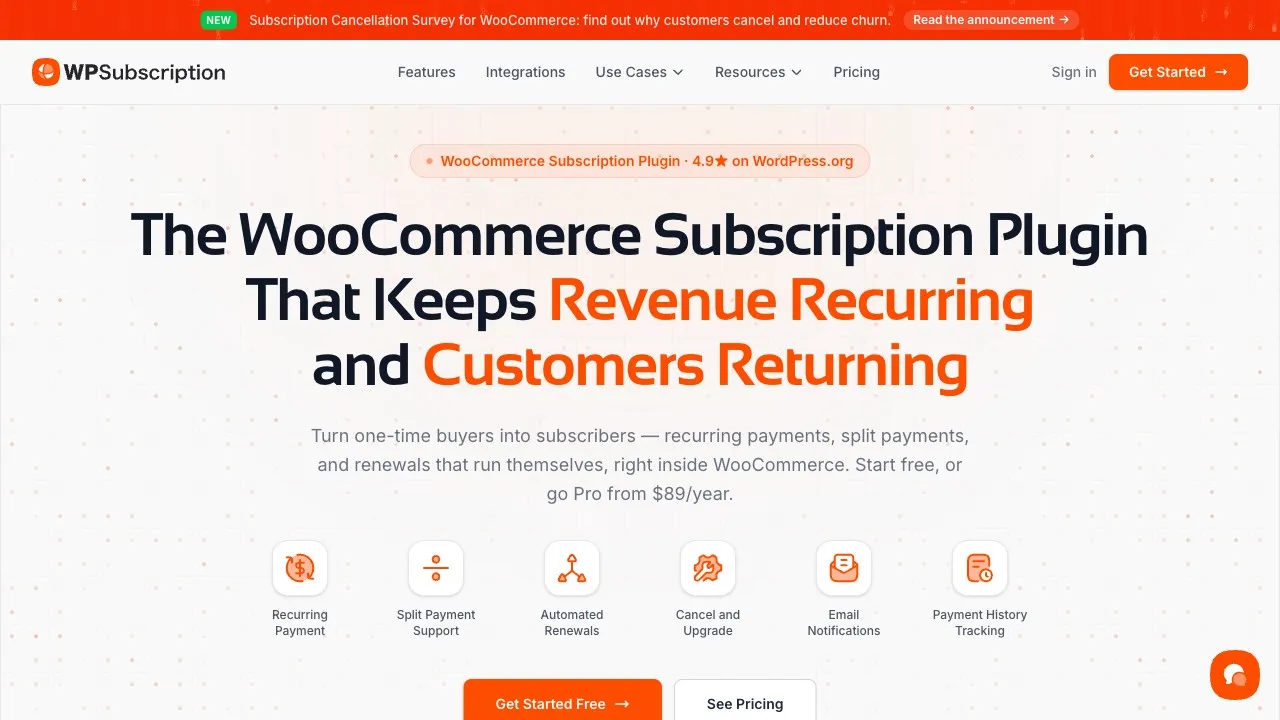
WPSubscription is a WooCommerce subscription plugin focused on simplicity and value. The free version on WordPress.org covers simple subscription products, free trials, daily to yearly billing cycles, Stripe and PayPal automatic renewals, and a customer self-service dashboard. Paid plans add variable subscriptions, sign-up fees, split payments, delivery scheduling, role assignment, early and manual renewal, upgrade and downgrade with proration, churn tools, and a REST API.
SUMO Subscriptions
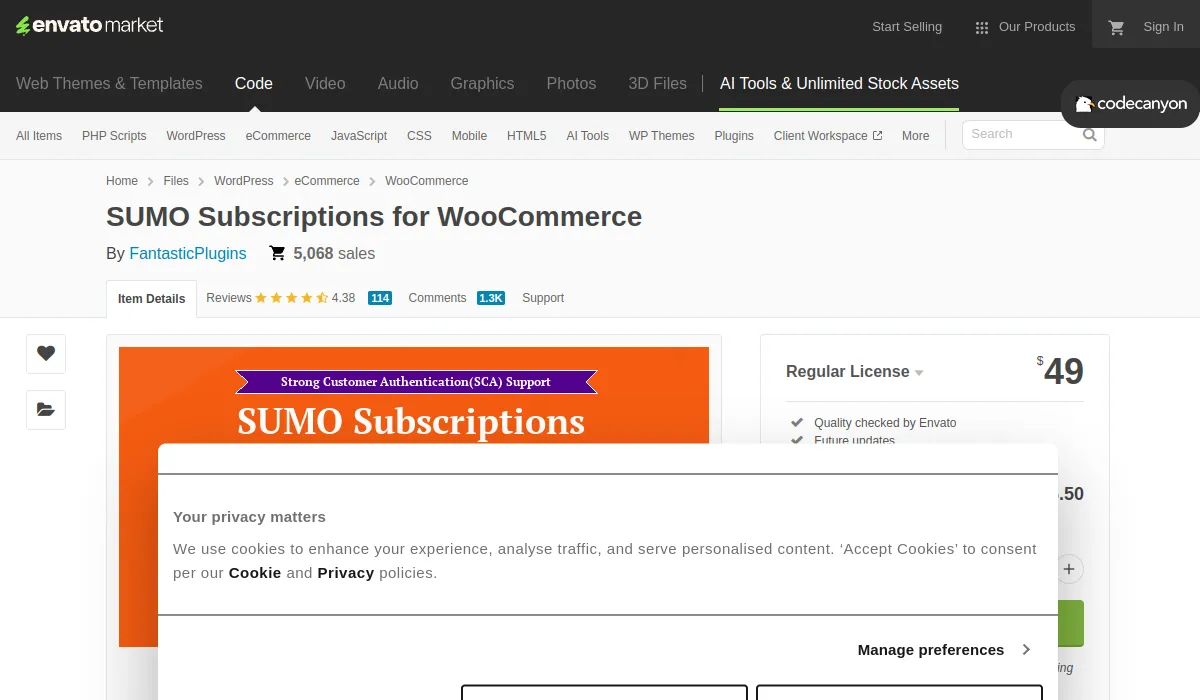
SUMO Subscriptions is a long-running plugin sold on CodeCanyon by FantasticPlugins. Its main appeal is a one-time $49 price rather than an annual subscription. It first shipped in June 2016, has had 143 releases since, and has sold more than 5,000 copies. It covers simple, variable, and grouped subscription products, free and paid trials, sign-up fees, installments, renewal synchronization with proration, whole-cart “Order Subscriptions”, and bulk updates. It also has a REST API and supports HPOS and the WooCommerce Cart and Checkout Blocks.
Comparison at a glance
| Feature | WPSubscription | SUMO Subscriptions |
|---|---|---|
| Pricing model | Free + paid ($89/yr, renewing at $129/yr; $199 lifetime) | One-time $49 (Regular License); $490 Extended License |
| Free version | ✓ | ✕ |
| Sites per license | 1, 5, or 50 by plan | 1 |
| Simple subscriptions | ✓ | ✓ |
| Variable subscriptions | ✓ Paid plans | ✓ |
| Free trials | ✓ | ✓ Free and paid trials |
| Sign-up fees | ✓ Paid plans | ✓ |
| Split / installment payments | ✓ Paid plans | ✓ |
| Renewal synchronization | ✕ Delivery-schedule sync only | ✓ With proration |
| Upgrade / downgrade with proration | ✓ Paid plans | ✓ |
| Customer pause | ✕ Auto-pause on low stock only | ✓ |
| Delivery scheduling | ✓ Paid plans | Limited (renewal sync, shipping in renewals) |
| User role assignment | ✓ Paid plans | ✓ |
| Failed-payment handling | Stripe retries (free); smart retry (paid plans) | ✓ Automatic retry and reminder emails |
| REST API & developer hooks | ✓ Paid plans | ✓ (docs ship inside the download) |
| Automatic-renewal gateways | Stripe, PayPal (free); Mollie, Razorpay, Xendit (paid); Paddle via WP SmartPay; WooEpay | WooCommerce Stripe, WooCommerce PayPal Payments, PayPal Subscriptions, SUMO Reward Points; manual renewal via any WooCommerce gateway |
| Updates | Free version via WordPress.org; paid plans while the license is active | Future updates included; manual zip upgrade |
| Support | Included with an active license | 6 months (12 for +$16.50); author’s ticket system, Mon–Fri |
Head to head
Pricing model
This is the core difference. SUMO charges once: $49 for a Regular License on CodeCanyon, which covers one site and includes future updates and six months of support. You can extend support to 12 months for $16.50 at purchase. If your end users pay to access the site, as on a paywalled membership, course, or SaaS site, Envato’s license FAQ points to the $490 Extended License.
WPSubscription is free to start. Its paid plans cost $89/yr (renews at $129/yr), or $199 once for a lifetime license. An active license includes updates and support. On license cost alone, SUMO is cheaper for a single store.
Interface and ease of use
This one comes down to taste, and we have not run a hands-on usability test of either plugin. SUMO’s admin has not stood still: its settings were revamped in version 14.0 (May 2022) and its checkout in 17.1.0 (August 2025). WPSubscription’s free version is the cheapest way to judge its admin: install it and set up a test product.
Features
Both cover recurring payments, trials, renewals, and customer management. SUMO’s feature set is broad. It handles simple, variable, and grouped subscriptions, paid trials, sign-up and recurring coupons, installments, renewal synchronization, upgrades and downgrades with proration, drip-fed downloads, and user-role assignment. Its Order Subscriptions let customers turn a whole cart into a subscription.
WPSubscription’s free version covers the essentials. Its paid plans add variable subscriptions, sign-up fees, split payments, upgrade and downgrade with proration, and role assignment. They also add delivery scheduling with delivery statuses and printable addresses, plus churn tools: Subscription Health metrics (MRR, churn, revenue at risk), cancellation retention offers, and Subscription Recovery win-back campaigns (Standard and Pro). For physical subscription boxes, delivery scheduling is the practical difference.
Payment gateways
Both support Stripe and PayPal. SUMO runs automatic renewals through the WooCommerce Stripe plugin, WooCommerce PayPal Payments, PayPal Subscriptions, and its own SUMO Reward Points gateway. Customers can also renew manually through any WooCommerce gateway.
WPSubscription supports Stripe and PayPal in the free version, and Mollie, Razorpay, and Xendit on paid plans. Paddle works through the separate WP SmartPay plugin, which suits digital sellers who want a merchant of record to handle sales tax.
Support and updates
SUMO’s license includes future updates and six months of support, extendable to 12 months for $16.50 at purchase. Support runs through the author’s own ticket system, not Envato, Monday to Friday, with a stated 1–2 day response. Upgrades are manual: you download the new zip, deactivate and delete the old version, and upload the new one. WPSubscription’s active license includes updates and support.
Where SUMO wins
- Lower license cost: $49 once for one site, with future updates included.
- Order Subscriptions: customers can turn a whole cart into a subscription and choose the frequency or number of installments.
- Renewal synchronization with proration, which WPSubscription does not offer (it only syncs delivery schedules).
- Subscriber controls: customers can pause, cancel, resubscribe, change quantity, and update their payment method. WPSubscription has no customer-initiated pause.
- Billing depth: grouped-product subscriptions, paid trials, sign-up and recurring coupons, drip-fed downloads, and overdue and suspend periods with reminder emails.
- Admin tools and compatibility: admin-created subscriptions, CSV export, HPOS (since 14.8.0), Cart and Checkout Blocks (since 15.4.0), WPML, and Action Scheduler.
- An ecosystem from the same vendor, including SUMO Memberships, Donations, Reward Points, Affiliates, and Payment Plans.
- A 10-year track record: 143 releases since June 2016, including 8 between August 2025 and August 2026.
Where WPSubscription wins
- A free version on WordPress.org with Stripe and PayPal automatic renewals. SUMO has no free version.
- Delivery scheduling (paid plans) with delivery statuses, printable addresses, and delivery-schedule sync. SUMO has no dedicated delivery schedule.
- Churn and retention tools: a free Cancellation Survey, plus Subscription Health metrics and cancellation retention offers on paid plans, and Subscription Recovery win-back campaigns (Standard and Pro, or a $58/yr add-on on Basic).
- More automatic-renewal gateways: Mollie, Razorpay, and Xendit on paid plans, and Paddle through the separate WP SmartPay plugin.
- Multi-site plans for 5 or 50 sites, and a lifetime option. One SUMO license covers one site.
Who should choose which?
Choose SUMO Subscriptions if you want the lowest license cost for a single store, or you need whole-cart subscriptions, renewal sync, or customer pause. You should be comfortable with manual updates and weekday ticket support. If your members pay to access the site, check whether you need the $490 Extended License first.
Choose WPSubscription if you want to start free, need delivery scheduling for boxes, want win-back and churn tools, take payments through Mollie, Razorpay, or Xendit, or run several stores. Split payments, delivery scheduling, and the REST API need a paid plan.
One-time vs subscription: the real math
The headline gap is the pricing model, so it deserves a closer look. SUMO’s $49 one-time fee is hard to beat next to a yearly license. But “one-time” comes with conditions worth understanding.
| Over 3 years | WPSubscription | SUMO Subscriptions |
|---|---|---|
| License cost (1 site) | $347 on the annual plan ($89 + $129 + $129), or $199 one-time lifetime | $49 one-time (Regular); $490 if you need the Extended License |
| Support included | While the license is active | 6 months; 12 months for +$16.50 at purchase |
| Updates | While the license is active | Future updates included; installed manually |
| Delivery scheduling | Paid plans | No dedicated delivery schedule |
SUMO wins on pure license cost: $49 against $347 for three years of WPSubscription’s annual plan, or $199 for its lifetime license. The exception is a paywalled site: at $490, SUMO’s Extended License costs more than either WPSubscription option. WPSubscription’s case rests on what its paid plans add for your store type, such as delivery scheduling, churn tools, extra gateways, or multi-site licenses. There is also a free WPSubscription version, so you can start at $0, but it does not include the paid features this comparison credits it with.
Updates and long-term maintenance
WooCommerce, WordPress, PHP, and payment gateways all change. A subscription plugin has to keep up or it quietly breaks. SUMO has a solid record here: 143 releases since 2016, 8 of them between August 2025 and August 2026. Version 17.7.0 is tested with WordPress 7.0.2 and WooCommerce 10.9.4, and the license includes future updates. What it does not include is support beyond six months unless you extend it, and each upgrade is a manual zip install. WPSubscription’s active license includes updates and support.
Which fits your store type
- Digital products and downloads. Both work. SUMO has drip-fed downloads and role assignment; WPSubscription has digital file access control and role assignment on paid plans.
- Physical subscription boxes. WPSubscription’s delivery scheduling (paid plans) tracks delivery status and prints addresses. SUMO has no dedicated delivery schedule, but its renewal sync and shipping-in-renewal options cover simpler box setups.
- Whole-cart or mixed orders. SUMO’s Order Subscriptions turn an entire cart into a subscription. WPSubscription’s paid plans allow a mixed cart of subscription and one-time items.
- Memberships and courses. Both handle the billing. WPSubscription integrates with LearnDash, LearnPress, Tutor LMS, and Academy LMS; SUMO’s vendor sells a separate SUMO Memberships plugin. If members pay to access your site, check whether SUMO needs the Extended License.
- Software and SaaS-style billing. WPSubscription supports Paddle as a merchant of record through the separate WP SmartPay plugin, and license-key integrations on paid plans. Paid SaaS access may also fall under SUMO’s Extended License.
Interface and team onboarding
If more than one person manages your store, try both admin screens before you commit. We have not tested either hands-on, so we won’t call one easier. SUMO revamped its settings in version 14.0 and its checkout in 17.1.0. It also lets admins create subscriptions by hand and export them to CSV. WPSubscription’s free version is a no-cost way to see its admin with your own team.
Frequently asked questions
Is SUMO Subscriptions really a one-time payment?
Yes. The Regular License is $49 once for one site. It includes future updates and six months of support, and you can extend support to 12 months for $16.50 at purchase. If end users pay to access your site, Envato’s license FAQ points to the $490 Extended License.
Does WPSubscription have a free version?
Yes. WPSubscription is free on WordPress.org with simple subscriptions, free trials, Stripe and PayPal automatic renewals, and a customer dashboard. Paid plans add advanced options for $89/yr (renews at $129/yr), or $199 once for a lifetime license.
Which has the better interface?
That is a matter of taste, and we have not tested either plugin hands-on. SUMO revamped its settings in version 14.0 (May 2022) and its checkout in 17.1.0 (August 2025). Install WPSubscription’s free version to judge its admin for yourself.
Do both support automatic renewals?
Yes. Both support automatic and manual renewals. SUMO sends payment, overdue, and suspend reminder emails and retries failed payments automatically. WPSubscription’s free version relies on Stripe’s own retries; smart retry logic, early renewal, and manual renewal need a paid plan.
Can I sell physical subscription boxes with either?
Yes. WPSubscription’s delivery scheduling (paid plans) adds delivery statuses and printable addresses. SUMO has no dedicated delivery schedule, but its renewal sync and shipping-in-renewal options cover simpler box setups.
Is a one-time price actually cheaper in the long run?
On license cost, yes, for a single store: $49 against $347 over three years on WPSubscription’s annual plan, or $199 for its lifetime license. Two caveats: SUMO support beyond six months costs extra, and a paywalled site may need the $490 Extended License. WPSubscription’s free version costs nothing, but it lacks the paid features covered here, such as split payments, delivery scheduling, and the REST API.
Will SUMO keep getting updates?
It has so far. SUMO has shipped 143 releases since June 2016, including 8 between August 2025 and August 2026, and its license includes future updates. Upgrades are manual: you replace the plugin zip yourself.
Verdict
SUMO Subscriptions is a strong pick if you want deep billing options for a one-time $49: whole-cart subscriptions, installments, renewal sync, and customer pause. You trade that for manual updates and weekday ticket support. WPSubscription fits better if you want to start free, need delivery scheduling or win-back and churn tools, use Mollie, Razorpay, or Xendit, or manage several stores. Its paid plans cost $89/yr (renews at $129/yr), or $199 once.
Compare all the options in our best WooCommerce Subscriptions alternatives roundup.
How We Compared
This is a documentation and pricing review, not a hands-on test. On October 9, 2026 we re-read each vendor’s public pages and recorded the version and list price below. WPSubscription facts come from its WordPress.org listing and our own pricing page.
| Product | Version checked | List price checked | Source |
|---|---|---|---|
| WPSubscription | Free 2.4.0 (Oct 8, 2026) · Pro 2.3.0 (Oct 6, 2026) | $89/yr (1 site), $149/yr (5 sites), $299/yr (50 sites), renewing at $129 / $299 / $599; lifetime $199 / $429 / $799 | wordpress.org |
| SUMO Subscriptions | 17.7.0 (Aug 2, 2026) | $49 one-time Regular License (USD, 1 site, future updates + 6 months support; 12 months support for +$16.50); $490 Extended License if end users pay to access the site | codecanyon.net |
What We Checked
- Each list price, what it covers (sites and term), whether a lifetime licence exists, and what it renews at, from the vendor’s pricing page.
- Each feature row against the vendor’s documentation, changelog, or WordPress.org listing. A ✓ means the vendor documents the feature; we say when it needs a paid plan.
- WPSubscription prices are our current prices, which renew at the regular price after the first year; multi-year costs include those renewals.
Limitations
- We make WPSubscription. We have tried to say plainly where competitors are stronger, but verify anything your decision depends on.
- We did not measure performance, setup time, support quality, or bugs for any plugin here.
- SUMO's documentation, including its REST API reference, ships only inside the plugin download. We checked SUMO's features against its CodeCanyon item page and changelog, so a setting not listed there may still exist.
- CodeCanyon shows $38.50 as the later price for renewing SUMO support. We could not confirm the exact terms once the support period has expired.
- Which Envato license a store needs is set by Envato's license terms, not by either vendor. Envato's FAQ points sites where end users pay for access (memberships, courses, SaaS) to the $490 Extended License; check your own case with Envato.
- WPSubscription's WordPress.org listing names a few features (sign-up fees, for example) both as free and as Pro. Where it is ambiguous, we have marked the feature as needing a paid plan.
- Competitor prices are list prices in the vendor’s currency, before tax, coupons, and time-limited sales. Prices change often; the date above is when we last checked.
Sources
- SUMO Subscriptions on CodeCanyon
- SUMO Subscriptions support details
- Envato license FAQ
- Envato item support policy
- WPSubscription pricing
Found something wrong or out of date? Tell us and we will re-check it and correct the post.